
A bride sits down.
The music is playing. Someone is fixing her dupatta. Another person is taking pictures. There is laughter everywhere.
And then someone says:
“Chalo, mehendi lagate hain!”
A cone touches the hand.
One line appears.
Then another.
A tiny flower begins to take shape, followed by a paisley, a leaf and suddenly an entire bridal design starts coming alive.
But here’s the interesting part:
The magic didn’t actually begin when the cone touched the skin.
It started much earlier—with the powder, the preparation, the paste and all the little steps that eventually bring that beautiful design to life.
So, what really happens between a packet of powder and those stunning bridal hands?
Let’s follow the journey.
It All Starts With a Little Powder
Before there is a design, there is Mehendi Powder.
At first glance, it doesn’t look particularly exciting. It’s just a fine powder sitting in a packet, waiting for its moment.
But this is where the whole process begins.
The powder needs to be prepared into a paste that is comfortable to work with. For detailed designs, consistency matters because the artist needs control over every little movement.
Think about it like cooking.
You can have all the right ingredients, but if the preparation isn’t right, the final dish won’t come together the way you imagined.
Mehendi works in a similar way.
The powder is only the beginning.
From Powder to Paste: The Part You Don’t See
This is probably the least glamorous part of the whole process—and one of the most important.
The powder is mixed and prepared until it reaches a workable texture.
Not too thick.
Not too runny.
Just smooth enough to move through the cone comfortably.
Why does that matter?
Because bridal mehendi isn’t usually made up of a few quick strokes.
There can be tiny flowers, delicate leaves, paisleys, mandalas, borders and intricate patterns packed into a relatively small space.
When the design gets detailed, the paste needs to cooperate.
Nobody wants to be halfway through a beautiful design thinking:
“Why is this cone fighting me?”
The Preparation Behind Henna Powder
There is also something fascinating about Henna Powder itself.
What looks like a simple powder eventually becomes the medium through which an artist creates an entire visual story.
The preparation stage is where the powder is turned into something that can actually be applied.
And this is why rushing through the process can make the application experience unnecessarily difficult.
The goal isn’t simply to make a mixture.
It’s to create a paste that feels manageable while working on the skin.
Because once the design begins, the artist needs to focus on the artwork—not spend the entire time trying to control the consistency.
Then Comes the Cone
Now we get to the part everyone recognises.
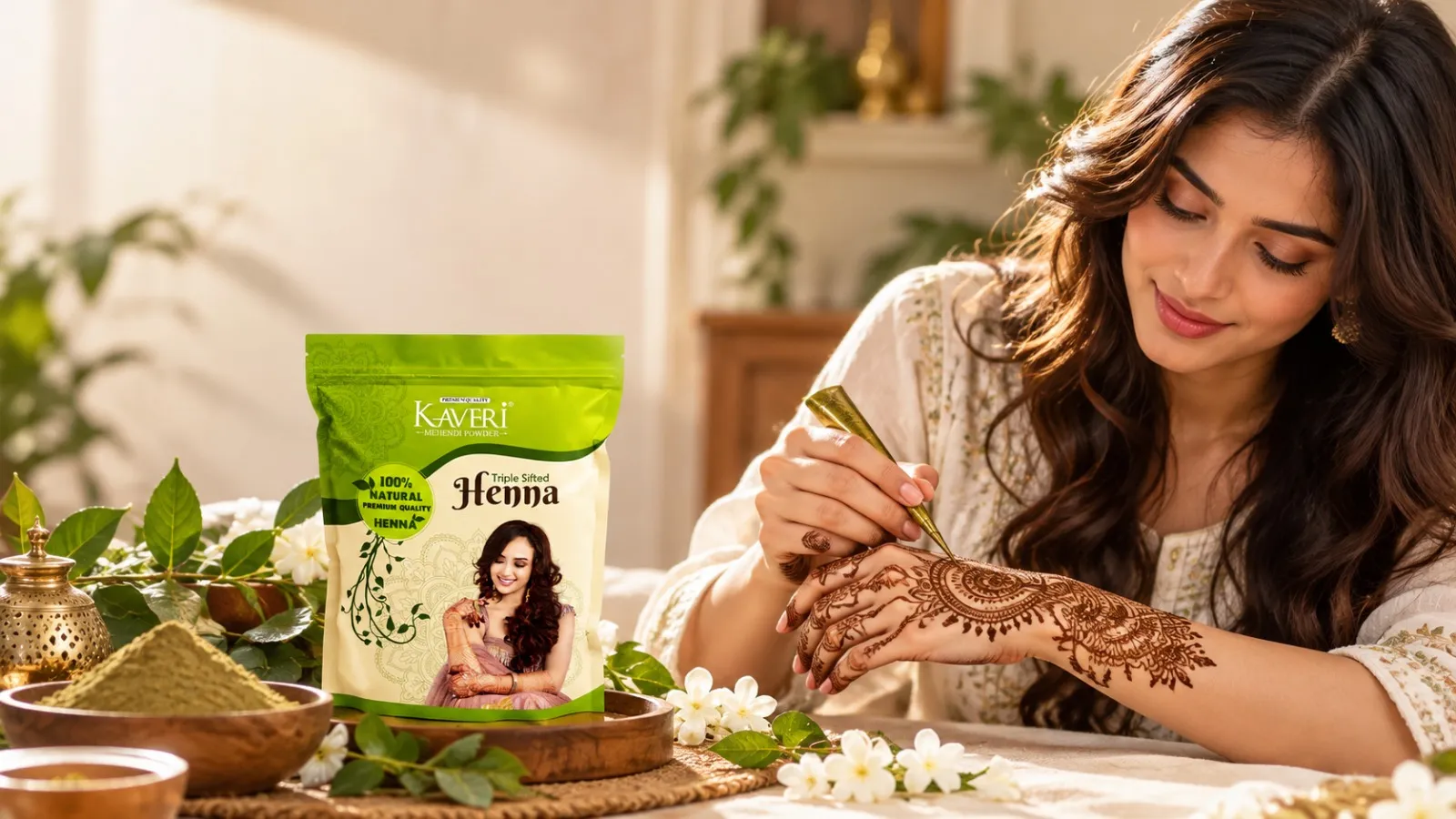
The prepared paste is transferred into a Mehendi cone.
And suddenly, everything feels much more real.
The cone becomes the artist’s drawing tool.
A gentle squeeze creates a line.
A small change in pressure changes its thickness.
A slow movement creates a curve.
A quick movement creates a sharper detail.
It may look effortless when you’re watching an experienced artist, but there is a surprising amount of control involved.
Especially when the design includes tiny details that need to be placed precisely.
Why the Cone Matters More Than You Think
Have you ever tried writing with a pen that keeps skipping?
You know exactly what you want to write.
Your handwriting hasn’t suddenly become terrible.
The pen simply isn’t cooperating.
Mehendi application can feel surprisingly similar.
When the cone is comfortable to handle and the paste moves smoothly, the artist can focus on creating the design.
When it isn’t, even a simple line can become frustrating.
This becomes particularly important for bridal designs, where hundreds of tiny details may need to come together.
Choosing a Henna Cone Is About More Than Looks
A Henna cone might look like a very simple little object.
But for the person holding it, comfort and control can make a big difference.
The tip, the flow of the paste and how easily the cone responds to pressure all become part of the application experience.
It’s a bit like choosing a paintbrush.
The brush doesn’t create the painting by itself, but the right tool can make the artist’s work much easier.
The same idea applies here.
What About Ready-to-Use Cones?
Of course, not everyone wants to start with powder and prepare the paste themselves.
And honestly, sometimes convenience wins.
Especially during wedding season.
There are outfits to finalise, jewellery to organise, appointments to attend, relatives arriving and approximately seventeen people asking the bride what she wants for dinner.
In the middle of all that, preparing mehendi from scratch may not be everyone’s idea of fun.
That’s where an instant mehndi cone for bridal application can be a convenient option.
It’s ready to use, which means you can move more quickly from preparation to the part everyone actually came for:
the design.
And Then… the First Line
This is where the whole thing changes.
The bride puts out her hand.
The artist positions the cone.
And then—
the first line.
It’s such a small moment.
But once that first stroke is there, the blank space isn’t blank anymore.
A curve becomes a flower.
A few lines become a paisley.
Leaves begin filling the spaces.
A central motif starts taking shape.
And slowly, the design begins to look like something much bigger than the individual strokes that created it.
A Bridal Mehendi Design Is Built Piece by Piece
One thing that’s easy to forget when looking at finished bridal mehendi is that you’re seeing the final version of something that was built one tiny element at a time.
There might be a large central design surrounded by smaller details.
A border may frame the hand.
Tiny leaves may connect two larger patterns.
Negative space may be intentionally left between elements so the design doesn’t feel overcrowded.
Some brides even include initials, wedding dates or little details that have personal meaning.
So while the finished design may look like one complete picture, it’s actually made up of dozens—or even hundreds—of smaller decisions.
That’s what makes it so interesting.
The Design Can Tell a Story
Modern bridal mehendi isn’t limited to one particular look anymore.
Some brides love traditional patterns covering almost every inch of their hands.
Others prefer a lighter design with plenty of open space.
Some want floral details.
Some want portraits.
Some want their love story hidden inside the design.
Others simply want something elegant that complements their outfit.
There isn’t one definition of a beautiful mehendi design.
The beauty is in making the design feel like your design.
From a Simple Powder to Something Personal
And that’s probably the most fascinating part of the whole process.
Think about where it began.
A packet of powder.
Then preparation.
Then paste.
Then a cone.
Then one tiny line.
And eventually, a pair of bridal hands covered in patterns that may become part of the wedding photographs forever.
The powder doesn’t look like a flower.
The paste doesn’t look like a peacock.
The cone doesn’t look like a mandala.
But somewhere along the way, all of these simple pieces come together through the artist’s hands.
And that’s where the magic happens.
Why the Process Is Part of the Beauty
We often notice the final result.
The finished lehenga.
The jewellery.
The hairstyle.
The completed mehendi.
But the preparation is where much of the experience actually lives.
It’s the excitement of choosing a design.
The conversations while sitting for hours.
The first line that makes everyone stop and look.
The moment someone notices their name hidden somewhere in the pattern.
The inevitable:
“Don’t touch anything!”
And, of course, the person who forgets five minutes later and accidentally smudges something.
Those little moments become part of the wedding story too.
From Powder to Memory
By the time the final design is complete, it’s easy to forget where the journey started.
But that beautiful bridal artwork has travelled quite a distance.
Powder → Paste → Cone → Design → Hands
Each step has a role.
The powder starts the process.
The prepared paste makes application possible.
The cone gives the artist control.
And the artist turns all of it into something personal.
That’s why mehendi is more than just another part of bridal beauty.
It’s a process.
It’s an experience.
And eventually, it becomes a memory.
So the next time you see a bride holding out her beautifully decorated hands, look a little closer.
Behind every tiny paisley and delicate flower is a journey that started much earlier—with something as simple as a little powder.
And somehow, that little powder became part of one of her biggest days.